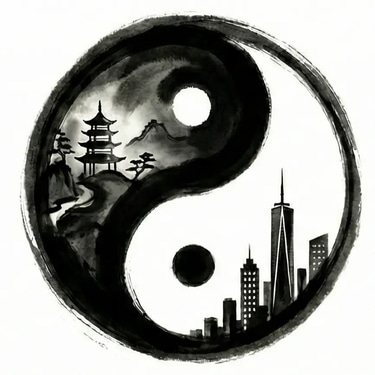
The Secret to Effortless Discipline: "Wu Wei"
Self-discipline isn't as difficult as it seems. By learning and mastering the concept of "wuwei" (non-action), you'll discover that self-discipline might be a false premise.
2/12/20263 min read
We know reading is beneficial to our mind and body, but we always end up picking up our phones instead of books; we know exercise is good for our health, but we pick up hamburgers instead of dumbbells. Everyone knows self-discipline is important, but most people find it extremely difficult to truly achieve.
Is it possible to achieve effortless self-discipline? The answer lies in ancient Taoist philosophy. The concept of "wuwei" (non-action) mentioned in the Tao Te Ching is the key to achieving effortless self-discipline.
"Wuwei" means acting in accordance with the natural laws of the universe, rather than resisting or forcing them. By conforming to the laws of the universe, we can achieve effortless self-discipline. So, how can we achieve "wuwei"?
Align with Your Inner Self
You find "self-discipline" painful because you often try to control yourself to achieve a certain goal, which in Taoist philosophy is considered "active action." You need to follow your heart and ask yourself deep down if this is something you truly enjoy, something you'd be willing to work hard for even without monetary reward or praise from others. Like a child running forward, not because they want a good physique, but because they find joy in the process.
So, prepare a blank sheet of paper and a pen, find a quiet place, and try "doing nothing"—no reading, no looking at your phone, no meditating. When all external noise is stripped away, you'll feel "emptiness," followed by a "natural impulse" to do something. Act in accordance with this impulse arising from "emptiness"—this is following your heart.
Create a Human-Centric Environment
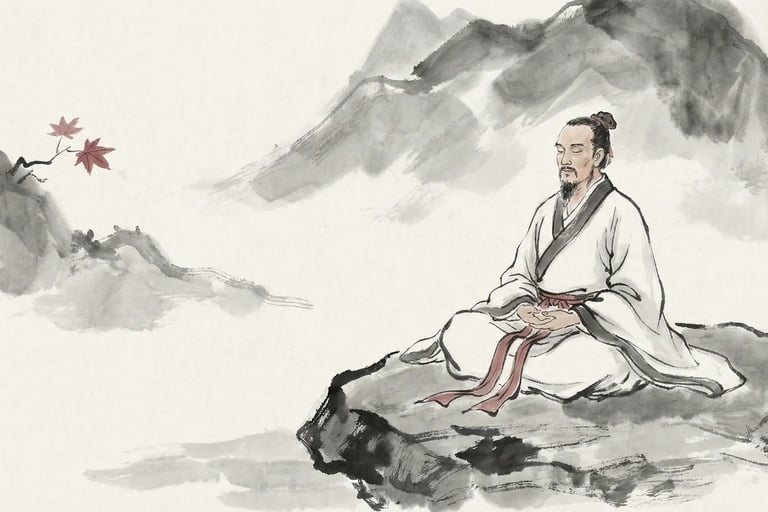
Taoism believes that individuals do not exist independently of their environment. If the environment contradicts your actions, self-discipline becomes a painful "going against the current"; conversely, if the environment aligns with your nature, actions will occur naturally, like water flowing downhill. If you feel that doing something requires immense willpower, it's because you're fighting against your environment.
Try creating an environment that aligns with human nature. For example, if you want to exercise daily, befriend people who enjoy fitness; if you want to practice an instrument, place it in a prominent spot in your living room, not in a corner. When you discover that you can achieve a state of flow without much willpower, you'll find that "self-discipline" is entirely a false proposition.
Be Like Water
Kung Fu master Bruce Lee famously said, "Be water, my friend," a saying rooted in Taoist philosophy. Water flows to the sea not because it breaks through rocks along its path, but because it adapts to obstacles, finding gaps and flowing with the terrain (natural laws).
Imagine the things that cause you pain as rocks, and yourself as the flowing water. If running hurts you, try walking. If you can't concentrate on reading for an hour, just read for five minutes. Remember, you should flow around the "rock," not fight against it.
Follow "Natural Law" (Tian Dao)
"Tian Dao" refers to the laws of nature. Taoism believes that anything that does not conform to the Way of Heaven is unsustainable. To align with the laws of nature, one must first consider oneself a part of nature, not a machine. If you treat yourself like a machine, you might try to apply someone else's self-discipline template, following their schedule, but after a few days, you'll completely lose the will to continue. The problem with this way of thinking is that you see yourself and others as the same "thing," but you are not; you are a human being.
You must realize that everyone is different, just as you can't find two identical leaves in the world. This is one of the laws of nature. Only you know your own biological rhythms and emotional cycles best. Exercise when you are most energetic, and read when your mind is clearest. Only by respecting your own body can you achieve true "self-discipline."
Make Management Invisible
The phrase "the best ruler is one whose subjects barely know he exists" comes from Chapter 17 of the Tao Te Ching. Imagine your consciousness as the ruler and your body as the people. True self-discipline is achieved when you no longer feel your consciousness "commanding" you to do something.
First, eliminate conscious purpose. Reduce mental preparation before doing something, such as, "I'm going to start reading," or "I'm going to the gym." Doing this should be "light" for you, without psychological burden. It happens naturally because you want to do it.
Second, eliminate the feeling of "I'm trying," and strive for a state of "selflessness." Focus on the process, not on pursuing a specific result. I want to go to the gym not to achieve a good physique, but because I experience joy in the process.
You don't need to consciously manage yourself; simply follow your heart and let everything happen naturally. Self-management will then become effortless.
Summary
Chapter 60 of the Tao Te Ching says, "Governing a great country is like frying a small fish"—even the hardest tasks become simple when you master the core philosophy. Join RealTao for weekly experiments in applying ancient Eastern wisdom to modern life.

Latest Video Episode
Connect
Stay in touch for Taoist insights
Subscribe to our Newsletter
simon@realtao.com
© 2026 RealTao. All rights reserved.
Support
Terms and conditions